

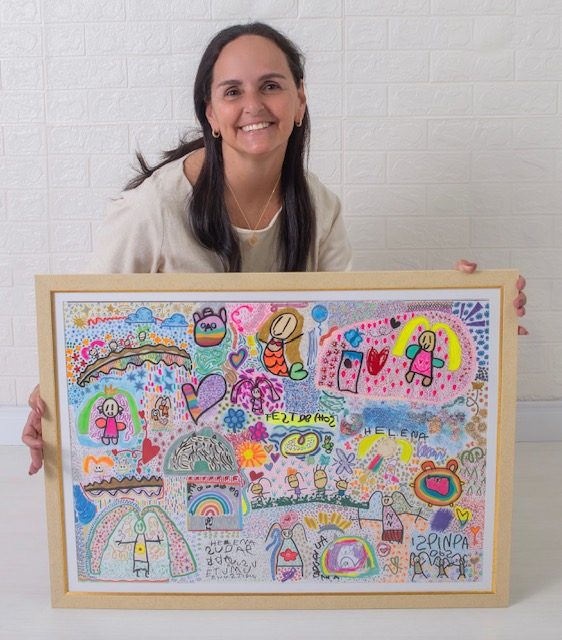
Leading the brand Doodle Art, the artist Sandra rejects artificial intelligence and transforms children’s sketches into 100% handmade affective art.
We live in the era of visual automation. With the advancement of artificial intelligence and digital filters, image creation has become instantaneous and, often, disposable. It is exactly against this technological urgency that the Doodle Art studio grounds its research. The brand rejects any type of computing or digital copying to focus exclusively on affective and manual art. The proposal is bold in its simplicity: transforming children’s first drawings—those meaningful scribbles that usually end up forgotten in drawers—into exclusive, colorful works of art ready to occupy home walls with the same rigor as a gallery piece.

Elevating Family Memories to the Status of Artwork
The project was not born from a corporate business plan, but from a sensitive observation of the family environment itself. The artist Sandra, founder of the brand, frequently saw her home table covered with the creations of her grandchildren, Helena and Joaquim. The desire to preserve that ephemeral moment of childhood led her to reproduce the children’s manual strokes into vibrant compositions. What began as a way to safeguard her own family’s affection scaled into a professional studio that today celebrates the childhood of hundreds of children. This trajectory proves that affective art holds real market power, as it deals with our most human necessity: the urge to freeze time.
Respect for the Original Archive and the Psychology of Colors
For a child, a drawing functions as a letter written even before they master words. Colors dictate emotions and shapes symbolize discoveries. Understanding this psychological weight, Doodle Art adopts a very strict ethical stance regarding memory: the child’s original drawing is never altered, cut, or used as a physical base. Sandra interprets each work “eye to eye,” respecting the imperfections and color choices of the little author. After the manual recreation process—which can take anywhere from 48 hours to 15 days, depending on the format—the finalized art is delivered framed, and the original sketches are returned to the family intact and organized in an exclusive brand folder.
Pointillism and the New Doodle Dots Collection
In addition to eternalizing children’s creations, the artist continues to expand her visual research with the launch of the “Doodle Dots” collection. In this new series, the patience and precision of manual labor reach a new level through the technique of pointillism. Using acrylic paint, Sandra constructs marvelous mosaics formed by thousands of tiny dots painted one by one. The result is a double visual experience: from afar, the canvas presents itself as a fluid abstract painting; up close, it reveals the texture, depth, and meticulous dedication of thousands of points. Since there is no automation, the free gesture guarantees that no work in the series is identical to another.
Accessing an Aesthetic with Emotional Purpose
Consuming this type of work is an active stance against the standardization of the decoration market. Instead of buying generic, mass-produced paintings, families begin to invest in their own history. For parents, architects, and collectors who wish to transform their children’s archives into lasting affective art, or who seek to commission exclusive pieces from the pointillist series, direct contact with the artist and the catalog of formats are available on Instagram [@sandradoodleart].
Supporting Doodle Art is the certainty that the purest memories of childhood will be treated with the dignity, calm, and aesthetic respect they deserve.
Source: www.revistacreator.com