
A multidisciplinary artistic practice that transforms memory, archives, and territorial displacement into visual experimentations, installations, and technology.

The visual investigation into the marks of time often begins with the direct observation of nature and expands into the complexity of human relationships. In the early 1990s, the starting point for visual artist and researcher Neide Marinho was the natural friction of surfaces, working with the bark of dead trees to transfer their fissures and deformations into painting. Over the years, this research on protection and wear shifted from organic bark to the skin, family archives, collected objects, and space itself. The surface came to be understood as a vast archive where time inscribes tensions and affections, allowing her current production to articulate body, memory, and the so-called “materialities of care”—technologies of survival that sustain, but can also cause erasures and ruptures.
Multiplicity of Mediums and Academic Thought
To accommodate this conceptual density, the production refuses restriction to a single technique. Her expanded practice moves fluidly between painting, photography, drawing, installation, video, sculpture, and experimentations with artificial intelligence and 3D printing. The materials chosen for each project range from papier-mâché, latex, jute, and crochet to aluminum, rebar, and botanical elements. All this material experimentation is grounded in a solid academic foundation, which includes a PhD in Communication and Semiotics from PUC-SP and a position as an associate professor in the Art Department at Universidade Federal Fluminense (UFF). Within the university environment, art education acts as an extension of the studio, fostering an interplay of repertoires and stimulating the students’ critical autonomy in dialogue with thinkers such as Ailton Krenak, Donna Haraway, and Leda Maria Martins.
The Immersive Impact of Artistic Residencies
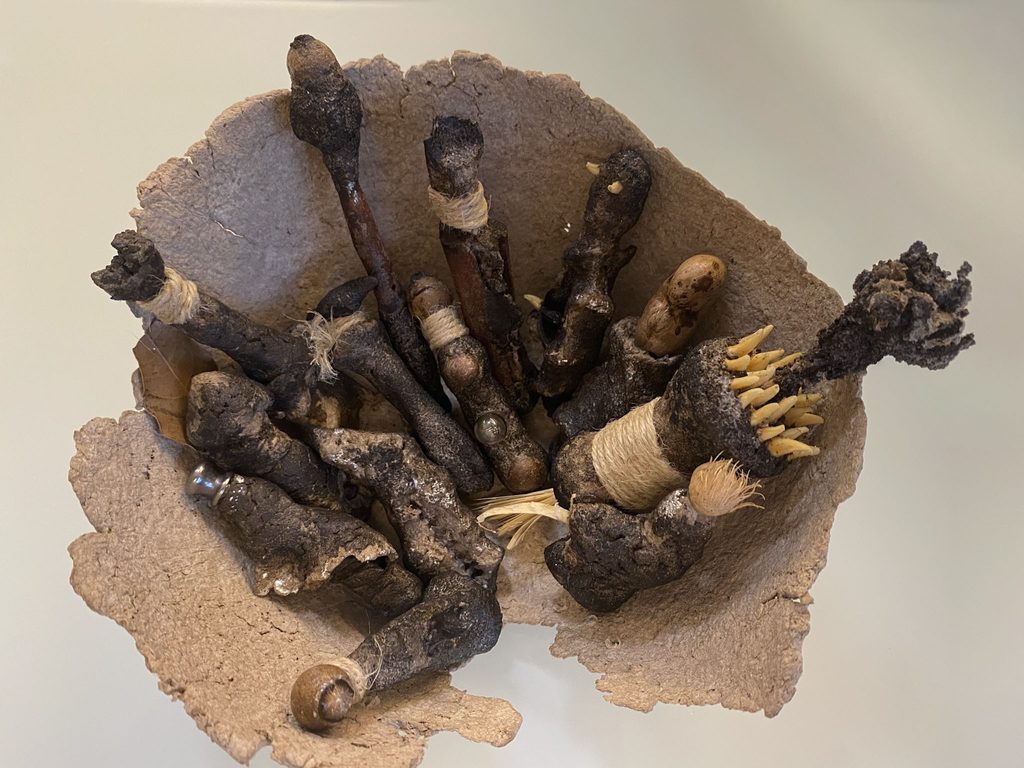
In recent years, geographic displacement has become a fundamental engine driving the advancement of her visual research. In March 2026, her participation in the 7th Residência Artística Volante, based in Cidade Velha, Belém do Pará, took place under an innovative telepresence format. Using images, audio recordings, and accounts sent by other artists, she developed the research project “Teletransporte afetivo: desenho etnográfico das presenças indiretas” (Affective Teleportation: Ethnographic Drawing of Indirect Presences), which combined artificial intelligence with the manual crafts of crochet and jute. That same year, immersion in the 3rd Residência Artística NACO in Olhos D’Água, Goiás, provided direct, physical contact with the Cerrado biome, resulting in the creation of videos and a sculptural installation composed of gourds and endemic elements from the region.
Upcoming Displacements and Exhibition Circuits
Mapping new territories and cultural frictions will continue to dictate her creative pace in the coming years. For early 2027, her immersion in the 9th Residência Artística Volante is confirmed, taking place in the Serra da Capivara National Park in Piauí to deepen her dialogue with archaeology and ancestry. Following this, the 10th edition of the same project, scheduled for 2028, will take her research to the extreme winter of Argentine Patagonia, testing the limits of the body and survival on a new geographic scale. Alongside these displacements, the exhibition circuit will host the shows “HO — Caixas: do museu ao mundo” and “A Invenção do Outro em Mim,” both examining identity and alterity in contemporary art. The complete process of these residencies, new installations, and reflections on care can be followed through her Instagram profile [@com_neide].