

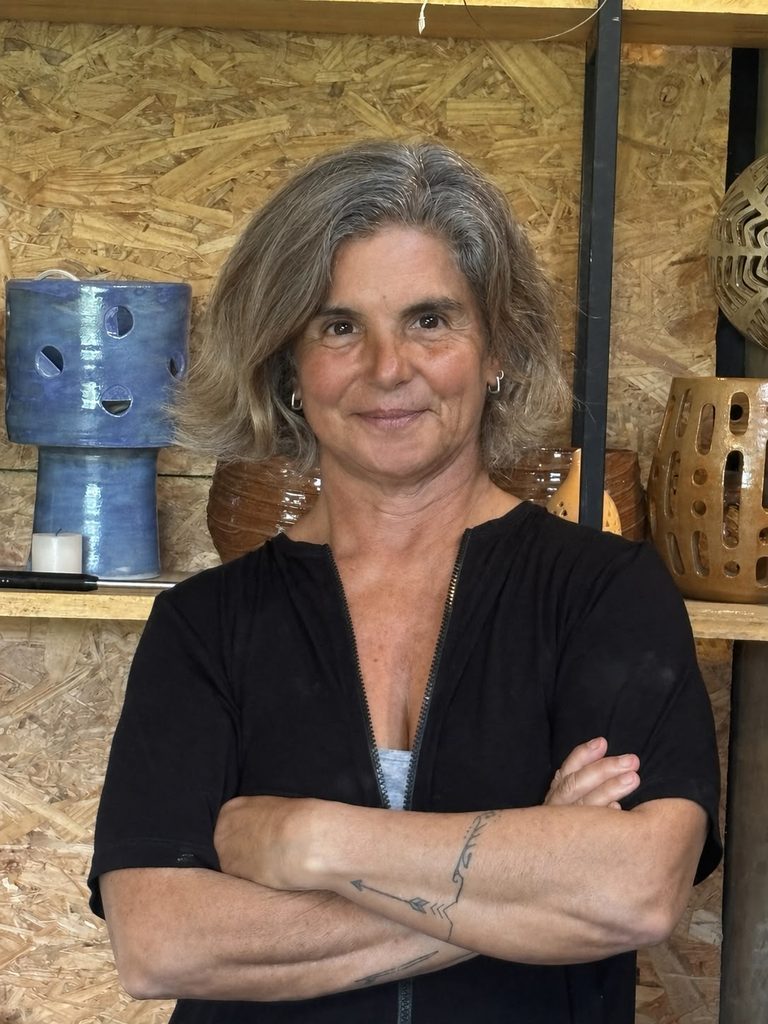
Visual artist Isabel Lacerda, leading Estúdio Monx, transforms clay into lamps and sculptural objects that redefine the relationship between light, shadow, and space.

From Literary Pages to the Materiality of Clay
Before devoting herself to the three-dimensionality of ceramics, her professional trajectory was established in the world of words. Born in Rio de Janeiro in 1966, visual artist Isabel Lacerda built a solid career spanning over 30 years in the publishing industry. As an editor at Nova Fronteira and later at the helm of Editora Nova Aguilar, she was responsible for publishing works by renowned figures in Brazilian and world literature. Her international experience included living in the United States, where she spent 16 years at Alexander Street Press, a pioneer in publishing digital collections for university research.
In parallel with editorial rigor, visual research was always present. Her artistic path passed through mosaic studies with Moema Branquinho and life drawing at the Escola de Artes Visuais do Parque Lage. However, it was from 2018 onwards that clay took center stage. Technical deepening occurred through ceramic courses and mentorships with names like Cecília Mônaco, Leonardo Baruk, and Karina Inácio, directing her current production toward the development of lamps and sculptural objects.
Light as a Structural Element and the Intentionality of Emptiness
The primary aesthetic differentiator of this production lies in the use of cutouts as the central element of her visual language. Crafted by hand in the clay, these pierced openings remove material to construct the design, allowing the passage of light, air, and the viewer’s gaze. The piece ceases to be an isolated object, existing instead through the relationship it establishes with the surrounding space.
During the day, the work’s presence is defined by its volume, texture, and the contrast between solids and voids. At night, the dynamic transforms: light passes through the handcrafted cutouts and projects new patterns onto walls and floors. In the Estúdio Monx studio, design and experimentation go hand in hand. Visual patterns reappear across different works, but always with intentional variations in proportions, spacing, clay bodies, glazes, and scales, gradually building a solid original repertoire.
Signature Collections and Dialogue with Landscape Design and Architecture
Produced as one-of-a-kind pieces or in small series, her creations cater to both indoor and outdoor spaces. The versatility of handmade work allows for custom commission developments in direct collaboration with clients, architects, and landscape designers. Several pieces have become defining milestones in this journey:
- Bafafá Collection: Small lamps crafted entirely from ceramics (both base and shade), featuring cutouts inspired by mid-century modern design. It was from this line that the structured commercialization of her work began.
- Damasco Lamp: Born from a residential project in Alphaville (SP), it is focused on outdoor spaces. Made from coarse-grained clay, the contrast between the rough surface and the warm light projected through the cutouts made it one of the main models for gardens.
- Ovinhos: Derived from research into outdoor areas, these are candle-lit lamps designed on a smaller scale for verandas, instantly transforming the environment with light and shadow.
- Esféricas and Véu: Recent productions. Esféricas uses clay recycled directly within the studio, while the Véu piece acts as a sculptural work where the pierced surface wraps around the volume like a membrane, filtering light and revealing its interior.
Coastal Influence and the São Paulo Agenda
Currently based in Itamambuca, in the municipality of Ubatuba on the northern coast of São Paulo, Isabel Lacerda finds in her daily coexistence with coastal nature the main reference for her concepts. The veranda, the garden, the open house, and twilight form the exact context for which many of her pieces are imagined.
Expanding the physical reach of her works, the artist will present part of her production focused on the relationship between ceramics, light, and voids in São Paulo on December 5 and 6, 2026, participating in the Futuro Mercado fair at the IBT – Instituto Brasileiro de Teatro. The complete archive of projects and releases from Estúdio Monx can be followed through her official Instagram profile [@isabel.lacerda_monx].
Source: www.revistacreator.com